
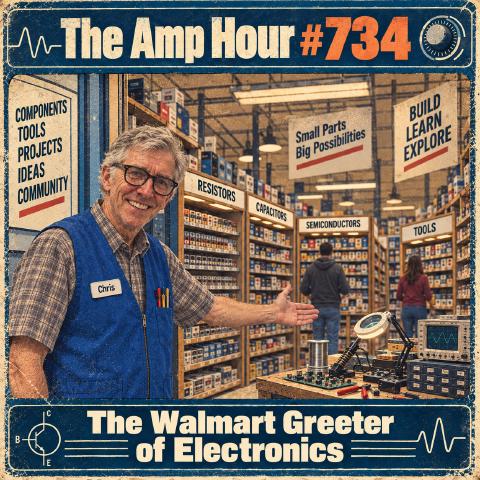
#734 – The Walmart Greeter of Electronics
Download episode · 92 MB
Also on Apple · Spotify · YouTube · RSS
Show Notes
Dave and Chris catch up on Dave’s visit to the University of Sydney Open Day, the shift toward practical hands-on engineering education, and open-source robotics like the Seeed Studio SO-101 and Hugging Face Micro Duck. They also discuss calculator forensics, Dave mentoring his intern Dylan through voltage regulator selection, AI-assisted PCB layout tools, why Chris wants to be “the Walmart greeter of electronics,” reverse-engineering the Rigol DNA800 network analyzer, Dave’s classic toaster design story, and news from Espressif and Build Australia.
Timeline
- Open Day at Sydney Uni: Dave discusses taking his son Sagan to the University of Sydney Open Day and wondering where all of their engineering graduates end up working. (00:00:45)
- Where Do Sydney Uni EE Grads Go?: They speculate on why University of Sydney graduates rarely show up in practical engineering job applicant pools, noting high international student enrollment and potential moves into fintech or graduate school. (00:02:30)
- Practical Engineering Education: Dave expresses surprise at the massive emphasis on practical, first-year hands-on projects across all engineering disciplines at Sydney Uni compared to past decades. (00:05:15)
- US vs. Australian Engineering Schools: Chris and Dave compare recruitment dynamics, big state universities like Michigan and UIUC, and smaller elite institutions like Rose-Hulman, Olin, and Harvey Mudd. (00:07:30)
- Larry Sears and Campus Makerspaces: Chris remembers past guest Larry Sears and his donation to build the 50,000 sq. ft. Sears think[box] makerspace at Case Western Reserve, comparing it to institutional makerspaces at Georgia Tech and Duke. (00:10:15)
- School Calendars & High School STEM: A quick look at Australian vs. US academic calendars and the rise of high school robotics programs like FIRST Robotics and Lego competitions. (00:13:45)
- Seeed Studio SO-101 Robot Arm: Chris shares his excitement about assembling the open-source SO-101 robot arm kit from Seeed Studio for trade show demos, using leader-follower training and Vision-Language-Action (VLA) models. (00:15:30)
- Hugging Face & Micro Duck Robot: They talk about Nvidia’s acquisition memes ($12.96B ASCII easter egg decoding to the hugging face emoji) and Pollen Robotics / Hugging Face’s upcoming $400 open-source Micro Duck robot kit. (00:17:45)
- Calculator Forensics: Dave describes explaining 4-bit processors and datamath.org Calculator Forensics to his son Huxley, testing internal register accuracy using trigonometric function chains like
arcsin(arccos(arctan(tan(cos(sin(9)))))). (00:20:15) - Mentoring Dylan on Voltage Regulators: Dave talks about guiding his second-year intern, Dylan, through parametric searching to pick a 3V fixed regulator for an ESP32-based product. (00:24:00)
- LDO Stability & Package Selection: Dave delivers an impromptu masterclass on SOT-23 vs. SO-8 packages, LDO loop stability at microamp quiescent currents, transient responses for LCD/Bluetooth burst currents, and dielectric differences between Y5V and X7R capacitors. (00:27:30)
- AI PCB Design & Astra Announcement: They review OpenAI’s Astra demo showing automated KiCad schematic generation and live 4-layer PCB layout routing. (00:33:15)
- The Walmart Greeter of Electronics: Chris explains why he refuses to gatekeep hardware design as AI layout tools lower the barrier to entry, preferring to be “the Walmart greeter of electronics” welcoming newcomers into the field. (00:35:15)
- Debugging & The Middle Gap: They analyze the gap between simple AI-generated microcontroller boards and complex high-speed multi-gigabit hardware, questioning where new engineers will learn root-cause debugging when boards fail. (00:37:30)
- History of Auto-Routers: Dave points out that automated PCB placement, auto-routing, and neural net hype have existed in EDA tools for over 30 to 40 years. (00:40:15)
- KiCad, Bezier Curves, and Trace Cloning: Dylan asks why KiCad’s schematic editor supports Bezier curves, and Chris highlights past guest Ian Scott Johnson contributing trace characteristic cloning features to KiCad. (00:43:00)
- The Power of Open Formats: Chris emphasizes how text-based open formats like KiCad, FreeCAD, and Blender allow AI tools to hook into hardware design, referencing past guest Robert Fennis and open FEM solvers. (00:44:45)
- AI in Semiconductor Design: They touch on an Asianometry video covering Synopsys and Cadence AI chip design tools, stock market drops, and token-based pricing models. (00:46:30)
- Reverse Engineering the Rigol DNA800 Scope: Dave details tearing down and reverse-engineering the RF board on Rigol’s DNA800 (Digital Network Analyzer / VNA scope). (00:48:00)
- RF PCB Layout Techniques: They examine gold-shielded PCB arenas, surface traces vs. inner-layer vias, and unusual stripline couplers feeding IF signals back into the local oscillator. (00:50:45)
- Leaving Mistakes in Videos: Dave discusses accidentally misidentifying a DAC as an ADC in his teardown video and leaving the mistake in to show authentic reverse-engineering. (00:54:00)
- The Toaster Designer Story: Inspired by the book Red Rising calling robots “toasters,” Dave retells his classic story of turning down a job designing a constant-temperature toaster controller because “toaster repairman/designer” was an old forum running joke. (00:55:45)
- The Toaster Chip Legacy: Chris references Episode 541 where they previously discussed dedicated toaster ASICs. (00:58:00)
- Edge Lab Live at Electronica: Chris mentions Edge Lab Live running a hands-on engineering lab at Electronica in Munich this November. (00:59:15)
- Espressif Launches Linux BSP: Chris highlights Espressif quietly launching a Linux BSP for the ESP32-P4 chip, as shared on the Contextual Electronics forum thread. (00:59:45)
- Build Australia YouTube Creator Job: Dave shares a job opening from Build Australia seeking a YouTube creator to visit and film local Australian hardware and manufacturing companies. (01:00:30)
Transcript
Chris Gammell: This is The Amp Hour Podcast. Release September 18th, 2026. Episode 734. The Walmart Greeter of Electronics.
Dave Jones: Welcome to the Amp Hour. I'm Dave Jones from the EEVblog.
Chris Gammell: And I'm Chris Gammell of Contextual Electronics.
Dave Jones: It's been a while.
Chris Gammell: It has been a while. How have you been?
Dave Jones: Alright, yourself?
Chris Gammell: Yeah, good. Everybody's back to school. Everything's, you know.
Dave Jones: Yeah, yeah.
Chris Gammell: I live near a university. Kids are at school. Yeah, yeah. So everything's kind of buzzing back to life around here.
Dave Jones: Ah, excellent. Speaking of universities, I went to the University of Sydney Open Day last, or weekend before last, which was interesting. Sagan, of course, is going into the year 11 here.
Chris Gammell: [unclear] college already, man.
Dave Jones: I think year 10 here is sophomore. So what's the one after sophomore? Junior?
Chris Gammell: Junior.
Dave Jones: Junior, yes. Yes, junior. And here it's, yeah, you're going into senior school. So, yeah. So you've got junior and senior, and then you go to university, right?
Chris Gammell: Ah, yeah.
Dave Jones: Yes. So he's, they're going to be the equivalent of a junior next year. So anyway, so we're thinking about, you know, just showing him around various, um,
Chris Gammell: yeah, like, you know, what school, what's college even like? Yeah, yeah. That sort of thing, yeah.
Dave Jones: Yeah, exactly. So we thought he'd start him early, you know. We only had time to go to one, and we didn't have time to look around, but now we looked around all their engineering, various different engineering departments. Nice. And, um, and the interesting-
Chris Gammell: I feel like this, sorry, I just feel like this era of like, like engineering school is so much cooler than it used to be. I'll just say that, and you go back to your saying, yeah. No,
Dave Jones: that's what I was going to discuss, actually, because the, the University of Sydney, right, is probably like Australia's oldest, and probably most prestigious university, you know, big sandstone wall, right? It is one of the sandstone universities.
Chris Gammell: Pomp and circumstance.
Dave Jones: As we call them. Yeah, yeah, yeah. Yeah. Right. But, but I've, I'm sure I've mentioned this on the show, probably several times in the past, and, you know, I've been in the industry for many, many decades. I've interviewed thousands of people, looked through thousands of resumes, right? Sure. And I can't ever recall any engineer who's ever applied for a job at any company I've ever worked for, or a colleague that has come from the University of Sydney.
Chris Gammell: Oh, interesting.
Dave Jones: So I'm wondering where the hell they all go. And it's not like they have a small engineering department. They have like, you know, one, like a big, you know, several hundred students per year, you know, where, where do they go? I don't know.
Chris Gammell: Financial services.
Dave Jones: Right. A lot of people have said that. So I did a poll on, I asked this on X, and yeah, everyone was saying that, you know, but they of course have a very, a famously high foreign student ratio, right? It's mostly foreign students who come in and I can understand. Okay. Well, they come in their parents, you know, get full tuition. Yeah. They actually pay for them to come here. Oh yeah.
Chris Gammell: Universities love that. Oh yes. Oh yes.
Dave Jones: That's the, that's the gravy train. And yeah, we, we, we have like a million students here or something. It's crazy, dude. Are you serious? Oh, I'm serious. I can get you the exact number. Um,
Chris Gammell: it's not a cheap city to live in too. Like just like, obviously it's like New York city style prices too. It's wild.
Dave Jones: Oh, foreign students in Australia. Maybe I'm off with the,
Chris Gammell: a million in the country or a million in Sydney?
Dave Jones: No, in the country, in the country. But you've got to remember, we only have like 27 million population, right? For the entire country.
Chris Gammell: That's why Sydney would have been a lot, a lot. Yeah. But yeah, okay. Exactly. Yeah. Here it is.
Dave Jones: Sydney had 680,000 international students in the January to May this year. Yeah. 680,000, but it's gone as high as 752,000. So yeah, it's yeah. We are one of the big, um, countries for foreign students anyway. So you can understand, um, you know, the foreign students buggering off after they, uh, after they get their engineering degree. Right. So it's like, okay, but that doesn't explain why I've seen almost zero in the industry that come from the university of Sydney. It's really odd. So I thought, Oh, I thought, Oh, they must be like really academic, like teach no practical stuff whatsoever. And that's why you never get a university of Sydney grad engineering graduate applying for a practical, practical job. Right. Cause as you said, they all go into FinTech or some other, you know, um, you know, they just go straight into grad school too. Or they go straight into grad school. Yeah. Yeah. That's a common thing. But that, those,
Chris Gammell: those students go somewhere too, right? Eventually grad students escape and, uh, you know, PIs try and wrangle them back in, but yeah, they do let them out once in a while. Yeah.
Dave Jones: But anyway, I was, I was actually stunned when I went to the open day, I went to all the university buildings. So I went to the, uh, chemical engineering. We went to the mechanical and aeronautical engineering. We went to the EE building, of course, which was brand spanking new, still at a fresh building smell. It's under 12 months old. Very impressive. for the, um, EE building. The VOCs. And, um, uh, what other one did we go into? Um, uh, the, um, civil engineering. I posted a photo. They had like this giant press, like this 3000 ton, giant press that's designed to compress, you know, steel bill beams that go into buildings and stuff. Anyway, very impressive stuff. And what I came away from that is my God, I can't believe how much practical, what an emphasis they have on practical engineering in all the branches. I was stunned. And yet, and we're talking to them, you know, and we're getting guides taking us around. They're telling everything. They're doing projects in the first year, right? They, they, they're doing like really cool projects in the first year. That's like, Oh my God, what? Seriously? Right.
Chris Gammell: Yeah. It was not a thing here. Yeah. When I went to school. Yeah. For sure. Yeah.
Dave Jones: I'm, I'm, I'm just absolutely stunned. And every branch of engineering, including EE are telling us all about all these cool projects that they do in first year, let alone second, third and fourth. Right. Or further if you're doing, you know, and yeah, I was just amazed. So I'm still even further puzzled, um, why I don't see any university Sydney graduates. So if there's any, any of our viewers out there, just avoiding you,
Chris Gammell: Dave.
Dave Jones: Right. Can let, let me know. I, cause I'm, yeah, it's, it's a thing. And I'm not alone in this opinion. I've asked many, like, I've noticed this for decades now and I've asked around and people said, yeah, I have, I don't know. I don't know. It is interesting.
Chris Gammell: Like I've seen, uh, different schools shuttle, like shuttle and have like, kind of like not fast path programs, but like, like they've recruited something coming from certain areas. They have, if you go to a certain employer in a certain region, many of their students come from one school. Yeah.
Dave Jones: They'll come from one school. Yeah. That's actually, if you like followed the path, right. It was like, okay,
Chris Gammell: a lot of people end up here and it's not for lack of opportunity elsewhere. It's just like, that is, that is the easiest on ramp. Um, sort of thing.
Dave Jones: Yeah. Yeah. Yeah. Yeah. So I guess they all get sucked up somewhere. Yeah.
Chris Gammell: Yeah. I've talked about recruiting, going to like school days, stuff like that. Right. Yeah. And honestly, the scale difference is also really interesting. So like I went to, you know, little Midwestern engineering school, not little, but you know,
Dave Jones: yeah, right.
Chris Gammell: not, not super well known. And like that had some employers in the area that were like prominent, but not like, not necessarily pulling from all over. But then I went to like university of Michigan, which is a nearby, very, very large school with a good EE program. Right. And they had like recruiters from everywhere. And same thing with like MIT recruiters from everywhere.
Dave Jones: As it, as it everywhere, you mean all over the country, they actually go to Michigan. Yeah, exactly. Yeah, exactly.
Chris Gammell: And I think it's some of it, just the prominence and kind of, okay. So this is a U S centric thing, but like the kind of the, the power distribution, like a, like a power law style distribution, like the amount of employers that want to hire from, MIT is just significantly, significantly higher. And so the, the demand, the demand at that job fair, it was radically different than elsewhere. So I went when had Tektronix had just bought Keithley. I was still there and Tektronix was paying for the booth and recruiting, whatever. And like people walk by and just didn't know what we were anything. Like, it was just like, yeah, I think we're talking about this year, like a decade ago. Yeah,
Dave Jones: yeah, yeah. And they just had no Tektronix. What? Right. Exactly.
Chris Gammell: And also like at the time, like why would they have been interested in that when they're getting recruited by Apple and, you know, FinTech and everything else? Like all of these, like Tektronix was not paying the same that others were. Right.
Dave Jones: Okay. Got it. That sort of thing.
Chris Gammell: So it could be, could be a similar thing. I don't know, but it is interesting how, how that kind of plays out.
Dave Jones: Yeah. Yeah. It's fascinating. Especially for,
Chris Gammell: for listening students as well. Right. Because like, I always kind of assume there was kind of like an egalitarian, you know, naive Chris, like, Oh, well, you know, like I'm at a decent school. I'm sure there will be decent opportunities. And, and, and to be fair, there were, there were, there very much were, but the scale difference, like the, the stepwise function, when you go from like top 50 to top 10 is significantly different. And I, I have to imagine it went in the other direction. I mean, talking to some of my friends that like that, that some state schools that were not well known for their EE programs, it went in the other direction. Right. So like that, that being the differentiator.
Dave Jones: Wow. So interesting. Yeah. Of course your scale over there is way different to the scale. Way different. Sure. What, what would a tip of what, what would a big engineering school in the U S how many EE students would they pump out each year? Do you know, do you have a ball? Well,
Chris Gammell: there's, there's differences though. So there's, there's large programs and then there's like, like highly established, um, like, uh, preeminent programs. Right. So like MIT is not particularly large. It is larger than case Western was. Right. But it was super, super well known. Whereas like university of Michigan was a massive, massive school that also happened to be a, a good EE program. And like university of Illinois at Champaign Urbana, like UIC, you know, U of I rather that was like near Chicago. Well, South of Chicago. Like that's the number four school in the nation, but it's like a massive school, like 60,000 kids. So then the EE program is just big too. I don't have exact numbers. So, so sometimes there were these combinations of like big school and great school. And, uh, sometimes it was just great school. Right. Where, like, so like another good example is like Rose-Hulman is a very incredibly tiny school in Indiana.
Dave Jones: Right.
Chris Gammell: Super well known. Well, super well known within the engineering community of the U S, but not like, not big by any stretch. Same with like Olin, same. Uh, so we've had guests on from Olin before our friends over at Embedded.fm, both went to Harvey Mudd. Like, those are all like smaller schools that are just like elite, you know, like really, really good institutions that are like super well known.
Dave Jones: Interesting.
Chris Gammell: But like almost like niche in a way, you know, it's like these different flavors.
Dave Jones: There you go. Well, the, uh, I asked the clanker, um, the Gemini clanker and, uh, U S universities award roughly 26,000 to 30,000 EE degrees across all levels, including bachelor's, masters and doctorates each year. How many? That's 26, 26 to 30,000. I'm given, given the number of universities in the U S I'm, I, I would have guessed a lot more than that.
Chris Gammell: I wonder if you like wrap it up with like other engine, obviously other engineering that gets much broader, but then you get like CE, right.
Dave Jones: Stuff that might cross over like biomedical mechanical mechatronics, you know? Yeah, yeah, exactly. Right. Right.
Chris Gammell: Like the naming kind of has had this like spreading effect sort of thing.
Dave Jones: Yeah. Hmm. Anyway. Yeah. We'd have to do a more extensive clank on that, but, uh,
Chris Gammell: yeah. Yep. So just to go back to the practical thing, I, that is, that makes my heart sing, right? So like, that's amazing.
Dave Jones: Okay. Yeah. Cause that was not my experience at all. So, you know, it's like, yeah, but I was stunned. I couldn't believe like every branch talked about it.
Chris Gammell: Did you get to go through any like EE facilities as well? Cause like, that's another thing. Yeah.
Dave Jones: Yeah. We went through the labs and stuff. Yeah.
Chris Gammell: Okay.
Dave Jones: Yep.
Chris Gammell: So like past guest of the show, Larry Sears, if you remember Larry, do you remember Larry?
Dave Jones: No, no, I'm sorry.
Chris Gammell: He was, he was, uh, very, he's still not, but like, uh, very, very kind, man. He, he sold his, uh, Hexagram was his, his, uh, wireless gas monitor gas meter monitoring business. And then he was one of the first, I think he was the first in-person guests of the Amp Hour. So this is a guy who's sold his company, donated a ton of money to my alma mater, Case Western Reserve. Yeah. And then he came over to my basement in, in Solon, Ohio. And then he came and recorded with me and Dave. So I will link that in. So like Larry, and he was so legit. I mean, he still is so legit, but like he, Oh, that was,
Dave Jones: that was forever ago. Yeah. Right.
Chris Gammell: Forever ago. It was literally our first, first and very few in-person interviews. Oh, wow. Yep. Yeah. Uh, and, but Larry, so he, part of his donation to the school, like his, his bequeathment of this thing, he set up something called, uh, the Sears, uh, whatever it's called. It's like this 50,000 square foot, whatever that is in meters, but 500 square meter, uh, learning center, basically like all just maker shop, seven floors of maker shop.
Dave Jones: Nice. Yeah.
Chris Gammell: Uh,
Dave Jones: wow.
Chris Gammell: And, uh, and then he also taught a class that I've definitely talked about on the show before that was called Larry Lab that was all taught out of the art of electronics. And like that is like, uh, that's like Larry putting his stuff into the.
Dave Jones: Nice. I'm actually reading an article on this now. We'll have to link it in. It's great. I'll send you the, uh, I'll send you the, yep. Yeah. But,
Chris Gammell: but that is not alone either. Like, so, so Larry is my like perfect example of this, but like this has happened at the place, like Georgia tech down in Atlanta, Atlanta, Emory. I don't know where the hell it is. Um, somewhere in Georgia, Georgia tech. Uh, they have like a very famous, um, maker space and things like it. I've seen one here at Duke. They're just, they've kind of popped up and become institutionalized as well, which is amazing. Right. You imagine they're opened up for not just the EEs or the MEs or whatever, which is what it was for me in school. It was like, Oh no, no, you want to do machining. You have to take the class for machining. Right. And now it's like, no, you want to go to the machine. You just, you know, sign up for training and then you try not to cut your fingers off. Right. Yeah. That's great. Yeah. Perfect. Really, really great moves in that direction. Um, you know,
Dave Jones: that's fantastic. Yeah. I was, I was very impressed. So I can't wait to, you know, unfortunately they're over for the year. We missed a bunch of them and yeah, we're just very busy on the weekend.
Chris Gammell: And what is the year there? I guess I don't even know. What do you mean? What is the year? When does school go from when to when? Um, when did you guys go? And when does the school year start and end? I don't, I don't know. Uh,
Dave Jones: February and ends in, uh, early December, I think. Hmm. Yeah. Why? Okay. Is it different?
Chris Gammell: Yeah, it's different. I mean, just it's seasonal here. So it starts in, uh, late August, like a couple of weeks ago. Okay. Yeah.
Dave Jones: You guys are, yeah. Yeah.
Chris Gammell: Then they'll take like a winter Christmas holiday. So like they'll go to like early December and then usually they'll start back up like mid January until May.
Dave Jones: Well, we do have intake. We do have mid year intakes as well. That is also a thing. Um, so yeah, but mostly, no, it starts from, starts by the calendar year.
Chris Gammell: Okay. Yeah.
Dave Jones: Yep. So that's why they all have their open days now in like August, uh, August, September kind of thing. Uh, September getting people ready for the, for the entry stuff, um, the following year. So,
Chris Gammell: yeah. Yeah. That's not that far off though, man. Huh?
Dave Jones: Yeah, I know. Yeah. Yeah. It's not, it's not far at all. Yeah.
Chris Gammell: There are like high school things that are happening to like Lego lab, like Lego, uh, competitions and stuff like that. Like the, what's it called? FIRST Robotics.
Dave Jones: Oh yeah. There's tons of those around. Yeah.
Chris Gammell: Okay.
Dave Jones: Yeah.
Chris Gammell: I mean, it's gotta be going nuts just from like the, the general robotics that are happening. Um, you know, I have a robot parts kit sitting behind me on the bench waiting to be assembled, Dave. I'm so excited.
Dave Jones: What sort of robot?
Chris Gammell: The SO-101.
Dave Jones: What's the SO-101?
Chris Gammell: So if you've seen like a, like a arm with a gripper on the end, like a little. Oh,
Dave Jones: right. Okay. So it's a multi-axis arm. Oh, okay. Oh, it's just an AliExpress. Okay. Yeah. It's a plasticky. Well,
Chris Gammell: It's Seeed Studio. It's a, it's open source.
Dave Jones: Has it got the hand on the end or is it the one with the gripper?
Chris Gammell: It's got the gripper on the end and then it's got a, it's got like a training thing too. So it's got a second arm that you train it with. So you can like do motions and like control it manually. And then you're basically doing training runs.
Dave Jones: Okay.
Chris Gammell: So, uh, Kevin, who was on the show, I don't know what's going to be two weeks ago, I guess by the time this is posted, he, he talked, he talked about it and that's what it was like. Oh, I should, I should totally get one of these for work. Right. Yeah. Yeah. Yeah. Yeah.
Dave Jones: Right. So you're thinking about for like, uh, like in person demos and stuff like that. You can do like demos with,
Chris Gammell: you see these things at all kinds of trade shows. Yeah. Exactly. So my colleagues are going to ROSCon.
Dave Jones: they had, yeah, the robot hands and it's just a cool demo, you know, and so, yeah, like a typical demo for this might be like, you have a camera, um, actually facing the person and then they move their hand and then it tracks the hand and then it moves the actual hand in real time to, you know, actually follow you. So yeah.
Chris Gammell: Right. Right. Yeah. Yeah. So what Kevin, Kevin was talking about on the show, he was talking about like, he's actually training it now so that it can do its own thing, like using, uh, VLAs, vision-language... A. Yeah. Right. But basically he's training these things so that they operate on their own now as well. Right. So it's not just a leader follower, not just a, you know, mirror the human. Now it's like, Oh, detect a ball, see a ball, grab a ball. Right. Yeah. Right. That kind of thing.
Dave Jones: So is there a, because it's open source, is there, is, is Hiwonder the company that actually makes and sells it or are they just multiple?
Chris Gammell: Yeah, there's, it's all, it's open source. It's 3d printable. So it's like basically people that are selling, uh, parts kits, like this is servos and then a controller board, stuff like it. So it's yeah. Open source really drives the cost down for that sort of thing. I got mine from Seeed, but this is actually a, it's actually Hugging Face, uh, which is, you know, you know, those people might be out to lunch. None of they got the $13 billion.
Dave Jones: Oh yeah. Didn't they get bored out? And who, who bought Hugging Face?
Chris Gammell: Jensen, Jensen bought them.
Dave Jones: Oh, right. Yes. Yeah. Yeah. That's right. Yeah. And there was a,
Chris Gammell: a cool 13 bill.
Dave Jones: Well, and apparently there was an Easter egg in the price of how much they paid for the company. Have you heard about that?
Chris Gammell: Oh no. There's an Easter egg. So it was like 12.9.6. Yes.
Dave Jones: If you actually decode that number and convert it into, um, ASCII or whatever, it's the, it's the Hugging Face emoji. So yeah, they actually got the, yeah, yeah. It's the, it's the hugging emoji. So yeah, they actually picked that number specifically to have a meme. Yep.
Chris Gammell: Yeah. I mean, so in terms of like accessible robotics too, I don't know if you saw, do you see the micro duck? That's like the new one. That's another Hugging Face slash LeRobot slash Pollen Robotics. I forget who's who.
Dave Jones: No.
Chris Gammell: Uh, it's like this cute, cute little, like, like duck robot. That's all like, they've got like a simulator. It's like out in the world and it like, it looks like almost like one of the Disney Imagineering style robots, but it's a $400 kit. It's coming out in December. So I think people can still sign up for it, but it's all open source. You can kind of see it. It's,
Dave Jones: I mean,
Chris Gammell: it's just wild. I mean, for 400 bucks, it's like,
Dave Jones: what's actually wild. Okay. Yeah. Yeah. Gotcha. Yeah. It's cool. It's cute. You know,
Chris Gammell: it's cute and you know, it's accessible. I think that's the, Oh,
Dave Jones: and it's got a little mouth that opens too. It's got a little duck. Yeah.
Chris Gammell: They can talk to each other. They can pick stuff up.
Dave Jones: Gotcha. Yeah. So it has a camera for a nose and yeah.
Chris Gammell: Yeah, exactly. Yeah. I mean, just teaching a lot of these concepts too, that are like super, I mean, super, super high level. Yeah. They're, they're such a good, like starting place. So I don't know if I'm going to be able to get a micro duck. Yeah. Right. I don't have a bit of wait till December, but we'll see. Maybe, maybe a little.
Dave Jones: In a year's time, people, he will have a closet full of a robot eval kits that he, you know, it's just like the old school eval kits, right? You end up with like a hundred different eval kits in your drawer.
Chris Gammell: It'll just be like robotic ducks in the closet. That are clacking.
Dave Jones: Yeah,
Unidentified speaker: exactly.
Dave Jones: Yeah.
Chris Gammell: It is. I mean, it's interesting seeing like what's kind of at the lowest level. Like I, you know, I always kind of like put robot at like this kind of pedestal kind of thing. Right. It's like, Oh yeah, I could never build a robot. And I mean, this is still a complex system, but like it's 15 servos. It's got direct feedback. It's got like all talking in a line. And then there's like a Linux single board computer that can take in, um, camera stuff as well. And then it's just like a 50 Hertz loop, you know, you know, I'm saying just, so like, you know,
Dave Jones: it takes a lot of process. Yeah. Yeah. Yeah.
Chris Gammell: It's just amazing.
Dave Jones: We have that these days. It's absolutely trivial, you know?
Chris Gammell: Yeah.
Dave Jones: Yeah.
Chris Gammell: Some weird times, man. Right. Some weird times. Uh, I don't like all of it, but some of it's cool, you know? Well,
Dave Jones: I was actually driving the kids to school this morning and little Huxley, you know, he, um, he said, um, how does a calculator work? You know?
Chris Gammell: And I was like, he was like, hold on a second, son. I have to pull up the car, uh, get the whiteboard out of the, out of the trunk. Yeah. We're going to,
Dave Jones: so both Sagan and I are explaining to him about four-bit processors and how they still use four-bit processors, you know? And this is like, you know, even, even computers in the 1970s, dinky computers in the 1970s, weren't even four bit. They were eight bit. Yeah. Right. That's what started the computer revolution. Yet a modern calculator might still use a four bit processor. Right. Crazy. You know? And yeah,
Chris Gammell: I mean, most, I think, I think the, the fair statement is most, most of the time, uh, modern calculators are, are using 64 bit supercomputers cause they're on our phone. Yeah, exactly. So anyway, you see son, when an app developer decides to try and make some money, uh, Oh boy. Well, that's great. How did it go? I mean, like,
Dave Jones: Oh yeah. Yeah. He totally understood, you know, but then we had to explain how they're hard coded algorithms in there. And, but how does it know every result? And it's like, we have to explain hard coded algorithms and stuff.
Chris Gammell: You know? it, it don't. Yeah.
Dave Jones: And then I got them to perform the, the calculator forensics, um, thing, the, um, nine, the sine of nine and then cos, tan, inverse tan, inverse cos, and then inverse sine. And it gives you a, a result out, which is not nine usually. Oh, so it's, yeah. Yep. And there's a huge, and the, Oh yeah, there's a huge data.
Unidentified speaker: Oh,
Dave Jones: calculator forensics.
Chris Gammell: Calculator.
Dave Jones: Calculator forensics. So if you Google that, there'll be a database, datamath.org forensics. There you go. Cool. And, um, you know, there's nerds out there. Um, I am one of them. Sorry. Um, that has, uh,
Chris Gammell: do not apologize.
Dave Jones: Sorry. It's arcsine. Arcsine. Yeah. Yes. No, sorry. I was right. Yes. Sine of nine. And then cos, tan, arctan, arccos, arcsine.
Chris Gammell: Is it because of like accuracy?
Dave Jones: It is accuracy. That's exactly what it is. Of course you are supposed to get the result nine. Actually, actually precisely because you're reversing all the operations, but, but, but you're going fast. So in so far into the nested loop that, um, you, what, what comes out is a rounded version of the internal registers. So from this, you can determine how many registers, you know, it might be an eight, eight digit calculator, but internally it might be 12, 14 digits, something like that. And all, and all the different processors, people have mapped these, um, for every processor going back to the, uh, 1974 is the earliest one, the TMC, um, the, you know, the TTI one, the O520 or whatever. And that gives a certain, uh, an actual certain result, which, which calculators that they're used in. And it's absolutely fascinating. So yeah. Anyway, there you go. Calculator forensics. Test your calculator today.
Chris Gammell: Yep.
Dave Jones: And there, there have been, um, some people over the years that have designed their calculators to nail this, you know, it's like, oh yeah, we're going to give exactly, precisely nine, you know, tweak their algorithms to make it. Detect, detect the sequence of key presses. And then just put nine on the screen. And then just put nine on the screen. It's hard coded. Yeah. Yeah. It was all the time. Yeah. Oh boy. Anyway.
Chris Gammell: Yep. I do wonder, you know, just cause now I'm thinking about like education and learning and practical and whatever, like who or what or how is going to make the calculators tomorrow, but like just the levels of abstraction. Like we're, we're at such insane levels of abstraction to this, just the point where we're handing stuff over to the clanker as well. Right. No, it's just like, how are we going to get people, back down to the bottom? Right. I mean, if someone's got to do, I've got to say, Oh,
Dave Jones: I've got the perfect segue here, dude. That was going to talk about.
Chris Gammell: Maybe I set you right up.
Dave Jones: Oh yes, you did. Thank you very much. My new employee, Dylan, right. Yeah. second year engineering. Yeah. Second year. Yeah. Second year. Use us a clanker for everything as all modern students do. Okay. And, and we're designing a product at the moment. We're finishing the design of a product, which I don't have time to work on. So he's doing a lot of the grunt, you know, work actually designing it. Um, and, uh, then we're choosing, you know, such a mundane thing, like choosing a voltage regulator. Right.
Chris Gammell: So I'm just imagining, like, I already know what the answer is. It's going to have an ESP32. It's going to have a ADS 1117, right?
Dave Jones: Like it does have an ESP32. Yeah. We stuck to that. Every,
Chris Gammell: every time a clanker needs a microcontroller, it's always an ESP32. Every time.
Dave Jones: Oh, but there's other reasons that we chose the ESP32. I know it's a good process.
Chris Gammell: I have nothing against it. I'm just saying that like, so many things are like, Oh, look, the clanker made me a circuit. It's got an ESP32. It's like, of course it does. Of course it does.
Dave Jones: Anyway. So we're choosing a voltage regulator and, you know, and like, I'm like, I actually demoed how to go through and find a voltage regulator using, using the parametric searches and all that sort of stuff. And I'm going,
Chris Gammell: okay. Use my hands. Like a baby. Like a baby.
Dave Jones: Which movie does that come from?
Chris Gammell: That's from, that's Elijah Wood in, in Back to the Future 2.
Dave Jones: Oh yeah. Yes. That's right. Yes. When they're like, they're like playing the video game in the future cafe. In the 80s cafe. Throwback cafe rather. Yeah. Of course. God, I should have remembered that. But anyway. Yeah. So, so, and he's like watching on amazed as I do parametric searching, you know?
Chris Gammell: Yeah.
Dave Jones: And, and then, so we, so we know we want a three volt voltage regulator, right? So it's got to be a fixed three volts. You don't want one of those adjustable, you know, like ex external resistors, right? It's just pain in the ass, right? You just don't want two extra BOM parts, you know, screw that. Yeah. Right. Right. Right. So, so we know we want fixed three volts. So we're searching for that. We know what max current we're searching for. So that really dictates the package. So, you know, we're not doing anything particularly, you know, high power with this thing, except in short bursts. Right. Yeah. So I'm going, oh, it's got to be a SOT-23. So it's either a three pin SOT-23 or five pin SOT-23, right? You really wouldn't pick an SO-8 package because really we don't need the extra power, you know, current capability that you might get out of an SO-8 compared to a SOT-23. And he's like, like amazed at all this stuff, but how do you know, how do you know you want a SOT-23, you know? And, and I'm trying to explain it. Well, you just do. It's the obvious choice. You know, it's, it's like, and this is something I guess the clank is not going to tell you, or they're not going to teach this in uni. Right. Of course. And yeah,
Chris Gammell: I think we are handing a lot of that stuff over for sure. Yeah. But I mean, I didn't learn that in university. I mean, you learned it on the bench.
Dave Jones: I didn't learn it there either. You know, so.
Chris Gammell: And that's probably how kids are going to learn it anyways, right? I mean, like that's, that's it. Even if the clanker does it, like you're going to get down to the brass tacks. Well,
Dave Jones: then I, then I started like, I should, we should have recorded this. Cause it was like 30 minutes of me just rattling down the rabbit hole of choosing a voltage regulator. Okay. So we need, uh, we know that we've got a, uh, Bluetooth module, which takes, we, and an LCD, which takes actually a couple hundred, could take up to a hundred milliamps or something burst current when it updates the screen. It's really low power, right? So we need a regulator that goes from micro amps output stability, right? So it's got to be stable at low currents, not all, you know, and I'm explaining the loop stability of LDOs, right? Not all of them are stable at extremely low current. Some of them might need a minimum current based on the decoupling and the loop, you know, the pole loop response and everything else. So I'm explaining all this sort of stuff. And, uh, and so we need, uh, you know, transient response stability. And then we're going into, and then I'm going into bypass caps. I'm going into 5YU dielectrics compared to X7Rs, you know, and, and things like that. And he's just, and his mind's exploding, I think, right? Um, at, at, at the detail of information that I'm, I'm pumping into all this stuff.
Chris Gammell: He's probably thinking like, oh crap, I have to learn all this stuff. Yeah, yeah, yeah. Well, no, no,
Dave Jones: no, no. He was really like, he really wants to learn it. You know, he's really like a sponge. Okay.
Chris Gammell: So I'm mapping out my own experience when a senior engineer would have been talking to me about them. Like, oh my God, I don't know. No,
Dave Jones: no, no, he was a sponge. and he, and he had the AI clanker there actually recording the conversation. So it transcribes it later. So maybe I can get the train. Oh, I might ask him for the transcribe thing from it. So, yeah. But we, I think we only started that like a third of the way or halfway through or something. He thought, oh, I should be, you know, turned on his, his clanker recording. Catching notes. Yeah. Yeah. Catching notes. Big, because it was, it was a massive dump of information on just picking a voltage regulator.
Unidentified speaker: Massive dump.
Dave Jones: Just a massive dump. Right? Yeah. I went down the bloody rabbit hole.
Chris Gammell: Steaming pile of information. Yes, that's right, Dave.
Dave Jones: You know, and then we're talking about, you know, stability and accuracy and all sorts of, you know, it's just, yeah, transient response. And it's just crazy. Yeah.
Chris Gammell: I think in a best case scenario, like the, the, the, the time from like not knowing to knowing is, is instantaneous now. Right. In theory. Right. Assuming you get all the right.
Dave Jones: In theory. It's, but you've got to know to ask it the right questions. Right. You can't just go off. Sure. You've got to, you've got to know to prompt the clanker. Okay. We've got this maximum and minimum current capability. We've got these current pulses. We've got these, you know, we want this X amount of quiescent current standby. You know, he didn't know about, you know, that they actually have quiescent currents and things like that, you know, which is really important. Compare it to like,
Chris Gammell: okay. Compare it to 10 years ago, 15 years ago, 20 years ago. Right. Like early Google, you had that, but like you still didn't know what to ask. And now it's more interactive. It's like, that's good. Like this is the not knowing is not new. Right. That is right. Yeah. Yeah. Yeah. Yeah. Of course. And he has the benefit of a senior engineer. Like that is still positive. I think the interesting thing is that there's a bunch of people that don't have that as well. So they didn't even know what to prompt about. Right. So like,
Dave Jones: of course,
Chris Gammell: like if the clanker is the instructor and the, the seeker of information, then it, the relationship changes. Now it's more like a validate, help me search, you know, make it interactive, this sort of thing. So like, yeah, it's.
Dave Jones: That is the thing with the clanker. It's not going to suddenly just volume dump. It's not going to suddenly info dump you and take you down, down the rabbit hole, unless you specifically ask it and guide it in that direction. Whereas me, I just went, I instantly went, okay, here's 30 minutes on bloody choosing a voltage regulator. And then we're going into, well, if we're going to mass manufacture this, you know, you want the SOT 30 and the SOT-23 part, because another reason you want the SOT-23 over SOT 8 is because you can fit more on a reel, you know, and then et cetera, et cetera, blah, blah, blah, you know, and it all goes down the rabbit hole. It's just, yeah, it's just, it's just crazy. And, and he, and he didn't ask me any of this. I just, you know, as a human, I just volume dump. Human. All this, you know, I went down all this, you know, yeah.
Chris Gammell: He was just sitting in a corner waiting for Dylan to be like, so Dave, what about SOT-23 here?
Dave Jones: I've been waiting all my life to volume dump on voltage regulators, you know, choosing a, you know, something innocuous, like choosing a voltage regulator, which for a lot of projects is just like, oh yeah, whatever, right? You can just throw anything in there, but this thing has sort of particular requirements that, that we care about. So, you know, yeah.
Chris Gammell: You have a particular set of skills.
Dave Jones: Yes. Yeah. I do. Yeah. I don't know.
Chris Gammell: It's interesting. I do. I, I, I, I, it's, it's the, it's kind of the push pull, right? I actually, some of it, I feel okay about, I think like for the people that are like, I think if Dylan was curious anyways, like he might've been fine with or without you there. Right. I think it's,
Dave Jones: would, would have eventually got it. Yeah. Yeah. Yeah. Yeah. Yeah. Yeah. Yeah. I think the thing I worry about generally that, that he never would have considered otherwise.
Chris Gammell: Yeah. So, yeah. I think the, the thing that's interesting to me is, is the, when so much is handed off and, and this might just be a pessimistic view generally. It's like, if so much is handed off, just like, Hey, client could go solve this. Right. Yeah. That. And, you know, and increasingly it is able to do that in some format, which is great. Then, then that curiosity is kind of. Yep. Not there. And that is probably just a pessimistic view because I think you've met, you know, young engineers. I met young engineers. It's just, it's just part of the DNA too. It's just like, you're just not going to stop. Well,
Dave Jones: it's based in the DNA and, and rather, rather than just going to KiCad and, you know, choose the component because they're from JLC. They happen to, you know, the parts are from JLC, JLC have the library and everything that has all the stuff instead of placing the manually and stuff. Oh no. You get the clanker to write the schematic file with all the components in there and hooked up. Right. And then you go in and then you tidy it up later. So you get it to automate all that as well. It's like, God. Okay.
Chris Gammell: Yeah. Well, so this is an interesting point that I want to talk about, which is the Astra six, or sorry, the GPT six Astra announcement came out. Oh God. The thing that was interesting to me. So, you know, I think, you know, yap, yap, yap, yada, yada, yada. Like, Oh, AGI is here. Yeah. Right. Okay. Fine. But, but the thing that's important to me, Dave is KiCad was on the front page of their demos.
Dave Jones: Right.
Chris Gammell: And that is interesting. Mostly because of like, mostly because of the reaction from the community, not necessarily from like what it can do. I think we're,
Dave Jones: yeah, we're,
Chris Gammell: we're already treading this path. We are, we're already walking down this path. There are startups upon startups that are doing this sort of thing. Some are very successful. Some are.
Dave Jones: Successful in quote marks. Successful means getting another round of funding. Right.
Chris Gammell: Oh, well, yeah, sure. Sure. I think successful, successful to me is like, I think they are significantly able to make layouts that are, make devices and layouts that approximate what people want. Right. And that at its base level is what people would, would pay for. Right. It's just to reduce the amount of time in the interstitial stage of like building electronics. Like they want to just get from, get to result faster. That's what most, that's what companies will pay for. And I think, I think some or many are actually achieving that.
Dave Jones: Some, some can do that. Yeah. Okay. Fair call.
Chris Gammell: Now, whether or not that is the best solution or the one that we want to, you and I want to use, I don't think that's the case, but I don't think we're the target audience, if I'm being honest. Yeah, sure. So I think it's interesting. Now, the thing now to switch from pessimist to optimist, I think if this draws more people in, right? This has been my take since I've seen all this stuff. If it brings more people into the industry that get wowed by DigiKey searches and are interested in electronics components. They think,
Dave Jones: they think that they can build something now. They think that they can build something easily.
Chris Gammell: That's great. I am going to be the opposite of a gatekeeper. I'm going to be, I'm going to be a Walmart greeter. That's what I'm going to be. Right. Come on in. The water's fine. I, you know, like get ready for some wild nights on the bench, you know, like,
Dave Jones: or are you like the, uh, Costco, welcome to Costco in, um, the, um,
Chris Gammell: yeah. In idiocracy. Yeah. Yeah. Welcome to Costco. I love you.
Dave Jones: Welcome to Costco. I love you. So you're more like the friendly Walmart or the, yeah.
Unidentified speaker: Yeah.
Chris Gammell: The Walmart greeter of electronics. That's what I want to be. You can be the Walmart. Come on in.
Dave Jones: I will be the, um, grumpy security guard. I will be the, um, idiocracy guy. Okay. Okay. Welcome to Costco. I love you. I love AI.
Chris Gammell: Yeah. Yeah. I think it's great. Now, now one question I have, uh, maybe you have thoughts about this. Okay. So someone decides to let her rip, uh, on Astra GPT six. Right. And they're like, all right. Sorry.
Dave Jones: Can we go back to the start and what?
Chris Gammell: Sure.
Dave Jones: Cause I have not looked into the details of this. I've just been seeing a flash by on my timeline and I went, uh, okay. They're routing a board or doing whatever. Um, what exactly did it do? And from what type of prompt? I don't know the type of I've seen.
Chris Gammell: Yeah. People have been posting. Yeah.
Dave Jones: But was it like a single layer board? Was it like a single? Yeah. I think so. I want this actual product. Design me a board and a schematic. Choose the parts yourself and go.
Chris Gammell: And do layout as well. So it's basically showing the, the live layout. So like, that was the wow factor was they were showing like a animated GIF of the, uh, GIF the actual parts moving as it's rerouting and stuff like it. It's a four layer board, microcontroller base, that sort of thing. So like, and, and, you know, people have been scrutinizing it. Oh, look this, you know, this disappeared, whatever. Honestly, it doesn't matter to me. The thing that's the community has been coming out about is like either scrutinizing it or saying, wow, look at this other tool so much better or my tool is so much faster. Yeah. Yeah. Of course. Hey, you know, yeah. I think it's just like, this is the moment we're in. So it has arrived at our doorstep. What are we going to do with it now? I'm going to be the Walmart greeter. That's great. Um, my question for you though is, okay, so now someone is going to try and one shot this thing or even just, you know, try and interact with it and put what they want on a board, go through JLC assembly or some other low cost assembler. The board arrives on their doorstep and it doesn't work.
Dave Jones: Yeah. Right. What happens then? You know, like, yeah, that's where the real learning happens.
Chris Gammell: I think so. Honestly. Yeah. That's exactly. Crack the book or talk to the clanker. And like, Oh,
Dave Jones: come on. They're not going to crack a book. They're going to go to the clanker again.
Chris Gammell: They'll probably go back to the clanker. Yeah.
Dave Jones: Oh, dude.
Chris Gammell: Yeah. You're right. You're right. But, but there might be learning to be had there. And so like, again, that's me being the one, you know, come on in, come on in. Yeah. Discounts on aisle five. And, you know, and that, I think that ultimately is fun. I don't think you or I, you are, you and I are not making our living doing layouts. And I don't think people who do make their living on layouts are doing it on four layer microcontroller boards or like sensors on board. Right. Yeah. Right. Yeah. That's not the hard thing, you know? Yep. So.
Dave Jones: Yeah.
Chris Gammell: Yeah. I think it's, it's fine. I think the only problem is, is that, so if we're talking about now the curiosity, we're trying to like drive curiosity, welcome people, this big tent, this big open Walmart of happiness. Right. like if they're skipping the in between part that they don't understand the, the why. And so then they may never make the jump to the, like, Oh, this is what I have to care about. Now I want to go do a, you know, a SerDes with like 10 gigabits per second per lane. It's just like, yeah. Yeah. Oh, there's a big gap between like,
Dave Jones: there's a huge gap between wiring up a couple of accessories to a micro. And yeah. Yeah. Yeah. Yeah. I know. There's a massive leap there.
Chris Gammell: So, so then that kind of like hollows out the middle. Right. And that, and then, you know, I, I'm confident that young engineers will either learn to do that or make tools that learn how to do that either way. But yeah, it's just, it's a weird time, man.
Dave Jones: It is totally.
Chris Gammell: Yeah.
Dave Jones: But ultimately I don't think it's doing anything smart here. It's just, it's just doing, it's reiterating, in doing a DRC until it passes DRC kind of thing. You know?
Chris Gammell: Oh, I don't know about that. I,
Dave Jones: you don't, you think it's smarter? Yeah, I think so. Anyway, I have not watched it. I have not seen the demos. Yeah.
Chris Gammell: I mean, you can, I mean, you just go watch the, go to the Astra announcement. I think, you know, the way I'm kind of viewing all this stuff is like, so just, it's just a couple of, about a year, year and a half behind, you know, JavaScript development and all that stuff. So like, so now if I like map my own experience of like, so now the people that I'm doing, I knew that were doing front end development, like where, where are they operating within the space? They're not like, they're not in the street. There, there have been some like downturns and things like it, but like, they're still involved in the ecosystem. I think there's still like taste making to be done within those, those spaces, but they're probably like, like a year, 10 years from now, like if any of us are expecting to be drawing lines on a page in the same way that we had 10 years ago, I think we're going to be disappointed. How about that?
Dave Jones: You got it.
Chris Gammell: Yeah. Yeah.
Unidentified speaker: Yeah. Yeah.
Dave Jones: All right. Yeah. I'm watching it now and it's like, yeah, okay, well, I'm sorry, but, um, you know, I've, I saw this 30 years ago. You know, there's been autoplacers and autorouters. People don't realize this. There's been autoplacers and autorouters, pretty decent ones for like 30 years, 40 years now.
Chris Gammell: Okay. So skeptic speaks up. There we go. Yeah. I mean, no one's surprised that Dave's on the skeptical side. Uh, I think, yeah, but hello.
Dave Jones: It's, it's true, right? We've, we've had auto and the technology that's gone into autorouters, right? Oh, it's neural nets. You know, Oh, that was all the rage back in the, you know, nineties to two thousands. Oh, it's neural networking. Look at this. It's like a human,
Chris Gammell: you know? Sure. But, but they were humans. I think we're just, the humans are a little bit more out of the loop. And I think that that is the big difference, right? I think that's the big difference across a lot of these things. That's going to be the continued trend.
Dave Jones: Yep.
Chris Gammell: And so like, so then like, where, where, where do we all kind of subsist, you know, from a making a living perspective, but also then like getting our design jollies too. Right. Yeah.
Dave Jones: I consider it like a, maybe like a first pass tool or something like that. Sure. Yeah. Like, you know, yeah.
Chris Gammell: Yeah. I, I, this is my list to, to try, to try out these tools. You know, I've got some, some GPT credits. I've got some, right. You know, and I've used Claude on some, you know, schematic checking in the past, you know, parts, parts checking, things like it.
Dave Jones: Okay. Yeah.
Chris Gammell: So,
Dave Jones: so yeah, I'm just wondering what the prompt for this, sort of thing is.
Chris Gammell: Uh, yeah.
Dave Jones: Just curious. Yeah.
Chris Gammell: Yeah. Yeah. Yeah. I think that's,
Dave Jones: it would be just like, just like traditional auto routing and auto placing the value, the, the true key to doing it. Well, is in the setup is setting up, setting up the rules to tell it how to do it, you know, and here is, is it inventing its own, you know, is it inventing its own rules? Is it getting that? Well, it's not inventing anything. It's copying. Yeah. Yeah. It's, you know, it's vast knowledge base of, you know, training data set or whatever. So it's just copying what other humans have done. Sure. Sure. Yeah. I don't know. That excited.
Chris Gammell: The riches are in the niches more than ever. I think, you know what I mean? Like, I think that's kind of what it comes down to. I do think we're going to see like, so I've been talking about like the sameness, you know, like we've just seen a lot of like sameness due to this, right? Like there's like the whole like dead, dead internet theory that there's like nothing new being generated on the internet. So like nothing gets indexed. It's new. And like the clanker is not good at coming up with his own thing on new stuff. So that's all fine. But my thing is like, it actually makes me like seeking out the weird, like more than before. I think actually like if you're making circuit boards, make them weird. You know, if you like weird art, weird, whatever, like even if it's not you making the art or whatever, just like prompting to add weird.
Dave Jones: This is interesting because Dylan was using KiCad the other day, obviously. We've talked about that. And he goes, sure, sure. Why does the schematic, he asked me, why does the schematic editor have Bézier curves? It's like, yeah. And it's a good question. And I said, oh, probably because somebody likes arty. Somebody likes doing arty-farty boards. And therefore they're probably, if they're doing arty-farty boards, they're probably going to be doing arty-farty schematics as well. And they want arty-farty Bézier curves, you know, to make it all look, we all pretty stuff. Yeah. Yeah. Yeah. Because all it takes is one per, because it's KiCad, right? It's open source. Anyone can actually contribute to it. Technically. Yeah. I think the, um, yeah. Yes. Yeah. Yeah. And, uh, yeah. Um, Ian Scott Johnston, I think it was Ian Scott Johnston, former, um, former show guest. Um, and of course, fellow YouTuber as well. Um, Ian Scott Johnston just posted the other day that he, one of, um, he made some additions to KiCad, which is going into the next build. And I went, yeah, where you can actually select, um, I think what it is, is you select a track. You can, uh, actually clone a trace. So you can choose a trace and then, you know, so it, so it takes the thickness and everything else about it. And then you just hit all the other traces and it clones the, um, actual, yeah, it clone, clones, the characteristics of those traces. And I'm going, that's pretty obvious, you know? Yeah. Yeah. But it apparently was not in there and he just added it and they're going to put it into the next build. So cool. Yeah.
Chris Gammell: I think that, uh, yeah. On a personal note, another thing that like excites me about KiCad being on the, the launch page of Astra, which is, you know, billions of dollars worth of work going into it. It's like, Oh yeah. Open, open formats. Those win, you know,
Dave Jones: that's the reason that's possible is because it's a text. It's a tech. Everything's text format. Exactly. It's a being schematic or text-based.
Chris Gammell: FreeCAD was also on there. Yeah. FreeCAD is not, uh, you know, racing up the charts of like, uh, but you know, when, so like, I don't know if you've seen like any of like the, the stuff with like blender has an MCP. I think FreeCAD has an MCP. KiCad has a, at least the library. I'm not sure if it has an MCP, but like, you know, again, you're just giving these hooks for the clanker to like hook into. And it's like, Oh, it'll, it'll do things that I'm just not capable of doing. And like, and that is an exciting time for kind of what's output from all this stuff and all the projects that are coming from it. So, yeah. Hmm. Yeah. It's gotta go up market, man. Up market. Ah, the bloody robots on my desk, you know, just to close the loop on the open format too. This is also the reason that I was really excited that we had, um, uh, Robert Fennis on the, on about the, the FEM, program basically. So like open simulation formats and things like it too. Right. So like, again, all of these things make it easier for learning, understanding, whatever, but open formats also allow the clanker to kind of do things that I have not been able to do.
Dave Jones: Yeah. Right.
Chris Gammell: Yeah.
Dave Jones: There was a new, um, Asian, Asianometry video. I think it came out. I watched it last night. So it's a new one that came out about, um, AI designing chips now.
Chris Gammell: Oh yeah. So I saw the headline. But it's,
Dave Jones: but it's not doing the whole process. It's just, it's not doing the place and routes and everything else and the synthesis and everything. So, you know, but, but still, um, yeah, it was dedicated to that. He was very impressed. He actually went to the conferences and stuff where they're actually presenting all this thing and all the buzz is that, um, yeah, Synopsys. And when they announced it, apparently, um, the big ASIC, uh, design tools, you know, your cadences and whatnot, um, their stock price fell like five, seven percent or something because of this AI announcement. So yeah, they're now having to scramble to go, Oh yeah, we're going to introduce, you know, because their tools are very proprietary. You sign an NDA, right? These are heavily locked up. They will, they will sue your ass into oblivion. If you dare talk about their actual tool and their processes and stuff. Right. Um, and yeah, so even they're saying now, apparently that, uh, they're going to have to offer, you know, hooks into the AI design tools and they're going to have to be charging for that. You know, they'll be charging for tokens and things like that as well. So anyway, that's all in that new Asianometry video. So yeah. Anyway, so I, yes, I am working on a, I'm back onto a project. which is really cool.
Chris Gammell: That's great.
Dave Jones: So hopefully we can,
Chris Gammell: do you feel like that forward momentum from obviously having Dylan there?
Dave Jones: Oh yeah, because I'm, I'm, I'm, I'm so backlog with shit, right? It's just, I've got so much backlog of so many products and mailbags and videos and reviews and, and everything to do. I can't work on an actual project. Whereas now I'm getting him to work on the project, you know? So, yeah. So he's doing, he's like your sub agent, you know? Yeah. Yeah. Yeah. Yeah. Doing the grunt work. So yes, yes, it's great. Otherwise I would never, you know, cause as I've said, I can't just do like an hour here, an hour there of an actual design. I've got to sit down for a whole week. You know, I can't just, yeah. I, I, I just can't start. Oh, where, where was I at again? And I've got to spend hours just coming up to speed of where I was at before I can do anything productive again. And it's like, you know, yep. Yeah. Really need a bulk of time dedicated to just working on it with no distractions. And I've got countless distractions. I've been doing tear down videos, uh, lately, tearing down new RF. I've noticed that. I've done two videos. I enjoy popular. They're very popular. It's up to 70,000 views already.
Chris Gammell: I wanted to ask you about this. So like, so you've been tracing this stuff out and you've been kind of, so this is the, the Rigol.
Dave Jones: The Rigol and the HAROGIC one. Yeah.
Chris Gammell: The, the name was kind of dumb. It was like a VNA, but they called it a DNA. Like what?
Dave Jones: A DNA. Yes. It's a VNA, but they called it, but the model is DNA. If you, if you actually want to go via the, by the scope, it is not the VNA 800. It's the DNA 800.
Chris Gammell: I think when you got that, you had just gotten that last time. I think it's digital.
Dave Jones: Yeah. Yeah. I just gotten it. Just turned up digital network analyzer. Maybe.
Chris Gammell: Yeah. Yeah. Not a huge fan of the name, but the thing looks amazing. And when, so when you pop the, when you top pop like the metal can off of this thing. Yeah. And then you were like, you did like an overlay of the photos you took and you were like able to trace it out. How do you actually, I was just, I was, I was like trying to visualize in 3d what the, what the board looks like. Right. Cause it's got these like metal, like a surface level, like metalized arenas. Yeah. Yeah. Yeah.
Dave Jones: It has the gold shield, the gold exposed soldermask shielding around each little subsection, you know,
Chris Gammell: be, be an amplifier. They don't have like a cut in the gate, right? It's not like a cut where like the signal goes through. It dives into the PCB to go to the next section.
Dave Jones: And often there's a few on there that is actually on the surface. They're actually on the surface. And then they do actually, yeah, there are a few in there. It's probably half a dozen where they actually mill out the shield. So it does actually go on the surface between them, but there's other ones that are, yes, they will jump through a via into the middle layers and then go under the shield, which is still like actually making contact on the top. And then, yeah, it actually jumps between layers, but there, there are ones on the top. So, yeah. So you can sort of see where it goes.
Chris Gammell: I was just, I didn't, I was curious about like, just kind of visualizing. Okay. So say it is diving through like the inner layer, right? So now you've got this big fence of ground plane all around me, right? It's like, I'm in a pasture and I'm like going down into a gopher hole. Yeah. But then does the gopher hole have additional fences? I'm really stretching my thing here. Probably,
Dave Jones: probably on the internal layers. It has like other fences around the gopher hole, right? Yes. Like,
Chris Gammell: and I didn't know what that looks like or how many layers the board is. Like, do you have any idea how many layers the board is?
Dave Jones: I don't know. I didn't see any side info or any marks on the board to indicate, but I wasn't really checking for that. you know, it may be there. If I had a look at the high-res photos or something, I don't know, because for those who don't know, it's very common. It's almost courtesy for a PCB designer to put a layer marker on the board, either on the silk screen or the solder mask or the copper or whatever, just telling you how many layers it is. And, you know, like, yeah, yeah. Or, or actually taking away the solder mask and then putting like little, um, exposed pads, like little squares on, on each layer. So you can hold it up to the light and you can physically see the little squares on each layer through the board, you know, right. Unless it's like a 24 layer board. Yeah. Yeah. Yeah. Yeah.
Chris Gammell: Yeah. Yeah.
Dave Jones: Right. I know. There's 24 layers and then you can't see jack shit. Yeah. Yeah. Yeah. Cause there's so much glass epoxy in there. It's just, it becomes totally opaque. Yeah. Yeah.
Chris Gammell: Yeah. I don't know like what it takes to, I mean, these are so high end. It feels like I'd never, ever be able to make something like this, but. Oh, RF,
Dave Jones: a lot of, you need a lot of experience and a lot of, yeah, a lot of experience basically to take, to get something like this first or second spin, you know, something usable first or second spin takes a lot of, you know, a lot of RF design experience. Yeah.
Chris Gammell: And it's always like, it looks like it's kind of like one of those like marble run things, but it's just like, where, where did the marble go? Right. Yeah. Yeah. Yeah. Yeah. Well,
Dave Jones: there's one thing in there, which I couldn't explain at all. And I double checked it. Like I thought, no, this isn't right. It's got these stripline couplers in there, right? These actual PCB, couplers. And it feeds back from the, from the IF frequency output of the low frequency mixer to the local oscillator input. I mean, I've never seen an RF design that feeds from the output, from the IF output back to the local oscillator input. I'm going, what the hell's, and, and a phase shifts at maybe 180 degrees. Maybe it's doing some, you know, everyone's guessing at it in the comments going, Oh, they might be doing some sort of performance cancellation, you know, thing, but I don't know. Anyway, it's odd, but that's what it looked like on the PCB. And there were,
Chris Gammell: I got to go talk to the clanker about this. You know what I mean? Like, it's like, it's like one of those areas where like, I don't feel, I don't feel in control of my own thoughts when it comes to some of this stuff. Right. I need like a book. I need something to grab onto, you know, I need to like deep rabbit hole on a clanker or something like it. Cause I'm just like, yeah, I just got that yucky feeling.
Dave Jones: Oh yeah. No, like, cause I'm by no means RF expert, you know, I consider myself a bit of an RF dummy, you know, it's sort of like, but I know the basic concepts, you know, so I can eventually figure it out.
Chris Gammell: Shift up, shift down, [unclear], phase this, phase that, right. is, is, is,
Dave Jones: so this, this RF switch here, is this an input and an output? Cause you can use them bi-directional, right? Cause they, you know, I've got, you know, and then I've got to sit down and think about it. Does it make sense? You know? So it actually took me all day, probably the good part of all day to do that. Um, just that, uh, block diagram thing, you know, cause I, you know, and you should see my early draft. It's got arrows going in the wrong, the wrong direction. So I like, I would do a first pass block diagram and then I'd sort of like first pass guess where I think the signals are going. And then I, when I want to redraw it, I look at it and go, no, that doesn't make sense. It must be an input, not an output. And then you eventually figure things out. And, you know, so it kind of like took me all day to do that reverse engineering.
Chris Gammell: The whole time you're just like your finger's hovering over, like, Shahriar's number. You're like, no, I shouldn't, I shouldn't call him. He's, he's very busy. He's important person.
Dave Jones: Yeah. Boy. So I eventually, one big mistake, which I left in the video. I, I, I left this in the video. Yeah. Yeah. The one right at the end. For those who don't know, I thought, and it was a reasonable, like, and I went and I left it and I left my explanation, my detailed explanation in the video of why I thought this is correct. I thought, okay, the final, it's a three stage RF, IX. It's a three stage IF, right? So out of the third mixer, then of course you've got low enough frequency, the 40 megahertz bandwidth to go into your analog to digital converter. But because this is both a real time scope and also a, a traditional swept scope, right? I thought, ah, they're probably using another ADC, which I thought I found like a TI. Was it a TI or an analog device? I don't think it was analog devices. Yeah. ADS. Yeah. ADS. And I did a quick Google of that part number and up popped ADC, but I didn't look into the details. So I thought, ah, they're using a higher bit, like a 14 bit ADC for just, they've got dual ADCs. They're ones for the real time fast, you know, um, one for the real time processing and a slower one for the sampling, whether to get better performance out of it. And it turns out, no, I was wrong. That was actually a DAC, not an ADC. But I kind of, I thought that was so interesting that I left that in the, that actual mistake in the video. And then I explained and redrew the stupid thing. But anyway, I thought that was interesting. So yeah. Hey man,
Chris Gammell: that's how you know it's not all clanker generated. Right. No, no, it's not all. Yeah. It's all spelling mistakes. Google. Yeah.
Dave Jones: Spelling mistakes in Google, Google searches. And yeah. Yeah. False Google, false Google results.
Chris Gammell: Bring it on.
Dave Jones: Yeah. Yeah. I don't think the clanker could have helped much.
Chris Gammell: I been, you know, referring to the clanker as the clanker for a while, as, as you have in one of the book, I've been reading the, the red rising, the second trilogy. And in that they have robots. And at one point they refer to one of the robots as a toaster. And I think that's going to work its way into my vocabulary as well. Yeah. Frigging toaster.
Dave Jones: Toaster. Yeah. Yeah. Oh boy. I, I told the story. I'm sure I've told the story of where I was once going to be a toaster designer. Hmm. Did I tell, have I, do you remember me telling that story? But he doesn't get it again now. I mean, here we go. Last story for the day. Probably new listeners out there, right? Last story for the day. I was looking for a job and there was a contractor. I don't know if it was contract or full time. I don't know. Anyway, at some little, little sort of not one man band design agency, but one of those contract design agencies, you know? So, you know, it sounded interesting. So I went in and he's, and he's talking about, oh, we're designing this toaster and we've got this patent on this, how, how it actually cooks the toast at an, like at a constant temperature. So it's like a constant temperature controller. And he claimed his patent claim that this was, you know, the perfect way to cook toast and everything. We need someone to, I need someone to design this constant temperature, not, sorry. Yeah. Constant temperature controller, you know, kind of thing for this toaster and actually design this toaster. And once I, you know, there were other jobs too, but then I thought, oh, do I want to be the toaster design guy? You know, because at the time I was on the forum, right? I was, I didn't have the EEVblog forum, right? I had the aus.electronics forum and the sci.electronics.design forum, right? The old, yeah, the old school. Yep. Forums. And the running joke on there was being a toaster design or, or a toaster repairman, you know, was, was like the lowest, you know, it was like the lowest rung of technical capability. It was being, and, and I'm going, oh my God, if anyone finds out I'm a toaster designer, you know, it's like, oh, I'm done for, you know? Yeah. So, yeah. So I turned it down because it was, I'm designing a toaster. It probably would have been interesting, you know, sounded like an okay job, but you know, yeah, no, I turned it down. So, I thought,
Chris Gammell: you know, this might've come up. I was just utilizing theamphour.com's wonderful search. Oh, yes. Yeah. Actually just, just okay. Search functionality, but there is a bunch of stuff in there, including all the transcripts. And back on 541, we talked about a specific ASIC. That was a toaster chip. And I think maybe, yeah, maybe I told the story. I was just remember some, we've definitely talked about toasters, internet of toasters. we've done,
Dave Jones: that was a chip of the week. Probably. That was probably almost certainly. Yeah. Yeah. Yeah. Yeah. What's that toaster chip? It's great. Just back,
Chris Gammell: back in the heady days of 2021. So that was, that was like, that was like deep pandemic, man.
Dave Jones: That was deep pandemic. That was pre-clank. Back in those days.
Chris Gammell: Pre-clank. Yeah. Pre-clank. Yeah. Yeah. My, my wife brought up the idea that like, she's like, oh yeah, you know, a couple of years ago before ChatGPT came out, I was like, no, it's been like a decade, right? She's like, no, it's been like two years, three years, Chris. I was like, oh yeah. She was way right.
Dave Jones: It hasn't, it hasn't been that long. It's just.
Chris Gammell: Another three years. We're yeah. It's all. Things are accelerating, you know, wild times, wild times.
Dave Jones: Yay. Oh, well.
Chris Gammell: Yeah. Yeah. We had a good run.
Dave Jones: We had a good run. We could retire now.
Chris Gammell: Yeah.
Dave Jones: All right. There you go.
Chris Gammell: A couple of, let's see, things that I wanted to just mention real quick before the end of the show. One, some friends are running something called Ed's Lab Live at electronica. Yep. I don't have a ton of details about everything that's going to be there, but basically electronica happens every two years in November in Munich. Yep. They're going to have like a hands-on lab. They're going to have like a very engineering focused thing there. So keep an eye out for that. If you're going to electronica. Mm-hmm. And Espressif launched a Linux BSP. I called this at embedded world last year. I walked up to the Espressif booth and I, I said, so when are you guys building a Linux thing? And they looked at me awkwardly and I was very vindicated back in two weeks ago when they launched a B, quietly launched a BSP for Linux for the P4 chip. So I'm expecting great things in the Linux world from Espressif. It'll be interesting to see.
Dave Jones: Okay.
Chris Gammell: Yeah. Yeah.
Dave Jones: Cool bananas.
Chris Gammell: Yeah. Yeah. You got any last minute links?
Dave Jones: Yes. I'll try and find it. I don't, I can't find it right now, but there's a new group in Australia called Build Australia. I think they are. I might have to correct myself down in the comments, but anyway, they are like, you know, we need to build things in Australia again. And thereafter, they've got a job opening at the moment. They want a video creator, like a YouTuber kind of person who goes around to all companies and films what they're building and stuff like that. So yeah, that's a, so I'll try and link that in down below. I'm not sure if it's already filled because this was a week or two ago. A couple of weeks ago. Anyway, I'll try and find the link to that. I thought that's really interesting. That's really cool. So yes, that's something that I've always wanted to do is like, you know, go around. That's, you know, if I had with my infinite time that I had available, go around and do videos, filming Australian companies that are actually designing and building stuff here. You know?
Chris Gammell: Yeah.
Dave Jones: I thought that'd be really cool. But then it probably only appeals to like an Australian audience. Well,
Chris Gammell: you know, I don't think so. I think, you know, like there's like similar channels for like, like even, uh, do you remember that, um, B link had done that for like, they were just doing the manufacturing processes. Oh yeah. Yeah. Yeah. That's right.
Dave Jones: Yeah. Fascinating. So yeah. If I can,
Chris Gammell: that stuff is, it's only like,
Dave Jones: more focus on the manufacturing than, Oh, this is Australian company. And the fact that it is Australian would be,
Chris Gammell: would be, would be secondary from a viewing audience perspective. Yes. Yes. It would be interesting. Right. Right. Yeah,
Dave Jones: exactly. I'm sure I could make it interesting. That's kind of what I do. Yeah. I'd like to think anyway. So yeah. I'm sure people think that. I would love to do that with my infinite, um, time and resources available. Sure. Yeah.
Chris Gammell: Time to hire another Dylan, man. Yeah. Right. Okay. Yeah. Dylan two, Dylan three. Yeah. Yes. Yes.
Dave Jones: Ah boy. Anyway. Yeah. All right. That's it. Catch you next time.
Chris Gammell: See ya.
Keep current
Every episode, plus the occasional job post, in your inbox.